
PLASTICS, POLITICS, AND POSSIBILITIES


Every Wednesday evening, here in the rural suburbs of NY’s Putnam County, we roll out the big blue tub of mixed recyclables to the roadside and pray that the local carting company eventually does their due diligence. Like most people, we really don’t know what happens to the plastics, the paper, the cans and bottles once they leave our driveway and get piled in the truck with everybody else’s stuff.
My personal dilemma about these everyday materials came up more broadly during a recent meeting of a conservation-minded garden club I belong to. The discussion that day was on the vast, endless sea of plastics we contend with every day, and what to do about it. Some people went right to the core, questioning why corporations which make plastic in the first place aren’t required to properly recycle those products at the end of their use. Others testified to their guilty feelings of disposing of plastics, like numbers 5 and 7, into their garbage, which then ultimately would be trucked out to the landfill because folks couldn’t find anywhere to recycle them. Add to that questions about packaging materials and aseptic containers, and unnumbered plastics, and we had one big headache. The solutions seemed so remote and vague, and the enormity of the problem confounded us.

In the midst of this discussion, however, I was reminded of a wonderful quote from the late sociologist C. Wright Mills (1916-1962), a brilliant and outspoken theorist, author, and educator. In his writings, Dr. MIlls shared the then provocative idea that ‘often personal problems are really social issues which demand political solutions.’
Mill's wisdom is illuminated in many ways, both past and present, in examples such as the long decades of grassroots lobbying and fighting for women’s right to vote, the campaign for an 8-hour workday, and for civil rights legislation, and for ending the war in Vietnam. And at the moment, there are so many issues that need real justice and structural change, whether it be the struggle to make businesses responsible for all the packaging they use and produce ; for decent wages; affordable childcare, housing and healthcare; environmental justice; or community protection against ICE and the flagrant lawlessness of the current administration.
I believe the phenomenon best known as the theory of “Social Darwinism” is pervasive in this country, wherein the strong rise to the top and the weak and incompetent wind up as societal losers who don’t know how to strive and succeed. Those people, it is believed, unfortunately lacked will power and consistently made bad personal choices. Of course, this is usually nonsense, but it is a devastatingly successful way by corporations to convince tens of millions of citizens to avoid looking objectively at the big picture – the way society is purposefully structured against economic, environmental and social justice.
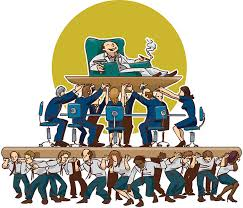
Sociologists call this tragic phenomenon “false consciousness,” whereby ordinary working people consistently vote and advocate against their own best interests, and ally themselves, unconsciously, with corporate priorities. When blue collar workers turned out for Ronald Reagan in 1980, that may have been the first large-scale and glaring example of this in recent years. Reagan soon lowered tax rates on the wealthy and corporations, cut social safety benefits, and fired 11,300 striking members of the air-traffic controllers union and then de-certified the union itself.

A more recent illustration of this “false consciousness” was when large numbers of Latinos, young, and working-class voters came out heavily for Trump in 2024, believing that he understood their issues and would be their champion in leveling the playing field. Media owned by the Murdoch family, the Ellisons, Sinclairs, Mercers or other right-wing extremists shape the views of millions of people who will ultimately be screwed by believing that the top 1 percent is representing their values. Planet Earth gets trashed and everything stays essentially the same.
But back to plastics and how this all fits in. A search on the internet asking how to deal with the pervasive tsunami of coffee cups, water bottles, containers, and the like brings forth a list of actions that, predictably, individuals can take , such as: utilizing cloth shopping bags, sorting plastics at home and learning how to locally recycle them, cooking more at the house and avoiding take-out and fast foods, buying in bulk, staying away from single-use plastics, and supporting a ban on plastic bags and Styrofoam. Against the increasing global tide of litter, however, these behavioral actions clearly do little or nothing to change the big picture.
As it turns out, 56 international companies are responsible for at least half of the world’s plastic pollution. These well-known businesses - Coca-Cola, PepsiCo, Nestle, Unilever, Walmart, Danone, etc. – were identified over a study period of five years (2018-2022) by volunteers who sorted through 1,870,000 pieces of litter, spread over 84 countries. (www.breakfreefromplastics.org) The rest of the litter, some 900,000 pieces, were unidentifiable.
Coincidentally, a similar David and Goliath battle is currently taking place in our state capital of Albany, New York where paid lobbyists for 100+ polluting corporations and their allies are trying to prevent the legislature from passing the “Packaging Reduction and Recycling Infrastructure Act (PRRIA), which would be a tangible game-changer here in the Empire State, in reducing waste. Representatives from Exxonmobil, Coca-Cola, McDonalds, and the American Chemical Council, among others, were able to stop these progressive new possibilities from being voted on when the bill came up in the state Assembly over the last two years. They are now facing, in a third protracted battle, approximately 300 environmental and justice organizations, and a legislature which is controlled by Democrats. The outcome, at this point, however, is unknown.
European countries appear, at least , to be far ahead of most of the US in dealing with plastics, as the EU policy of Extended Producer Responsibility (EPR) now mandates ” that producers bear financial or operational responsibility for the entire lifecycle of their products, particularly disposal and recycling….(and where) regulations cover packaging, electronics (WEEE), batteries, and textiles, aimed at achieving……. 70% recycling by 2030.” (google AI) In the US, seven states have passed laws that create Producer Responsibility Organizations (PRO) which force manufacturers to pay into a common fund that comprehensively upgrades state-wide recycling operations. How well this works in reality is beyond the scope of this essay, but at the very least it points in the right direction.
Our garden club’s conservation committee recently decided to invite the executive director of Just Zero – Kirstie Pecci, ESQ. - to speak to our community later this month, and to share her group’s strategies and successes for reducing plastics and waste. Just Zero is a “national non-profit working to implement just and equitable zero waste solutions around the country.” They work across a wide arena of issues, from composting and solid waste systems to bottle bills, the reduction of packaging, and to textile recycling and to other associated concerns. Their philosophy seeks to “put people and the planet first,” while promoting DEI values.

I recently interviewed Kirstie from her offices in Massachusetts, and she suggested that two of our most troubling environmental problems are widespread and pervasive toxicity, and the climate crisis, and that in order to claim some success in this arena, “people need to see that it’s important to work on both issues at the same time.” But “the thing we see over and over again,” she said,” is that folks think there’s going to be a silver bullet – a technological solution – to these and other problems. Capitalism, however, drives business systems, absolutely pushing everything in the wrong direction. Corporations are not, unfortunately, taking responsibility for externalities (the wastes they create) and they’ve been allowed to buy politicians in this country. We have to lead people to take systemic political and social actions.”
I asked her for some specific acts we can collectively take, and she immediately said that “hyper-local pushback by focused grassroots groups works very well.” As an example, she said, “city, town, and county campaigns have had a lot of success in pushing for widespread and comprehensive composting, for getting municipalities off of ‘mixing recyclables’ into something much more efficient, and for locally creating ‘green jobs. For us,” she said, “empowering communities is more important than ever before. We can do this.”
In late January, the governor of New Jersey signed a bill called “Skip the Stuff,” which bans both dine-in and take-out restaurants from giving away plastic utensils and condiment packages to customers, unless specifically asked for. This state-wide action took place after political pressure from over 60 towns and municipalities that had previously passed their own Skip the Stuff ordinances. Research by several organizations shows that approximately 100 million such utensils are used and disposed of everyday in the U.S. On the brighter side, NYC, Seattle, Denver, and Washington, DC have already passed their own versions of Skip the Stuff.
Idealism and belief are unique and often powerful forces. Against the tide of plastics there is a large conference, organized by the Beyond Plastics Network, coming up soon in Philadelphia of regional organizations dedicated to reducing this situation, and the impressive title of their meeting is “Radical Optimism for a World Beyond Plastics……”
With a title like that, how can I not go? I hear there are still some tickets left. I’ll be glad to drive there so we can carpool. Can I save you a seat?


I sure wish we would lobby for more hemp based products. They make clothes, houses, wood flooring, rope out of hemp. There are a million uses.
So much info in this great article, Pete! Thanks for highlighting the PRRIA fight, it sure would be a game-changer for NY State. Also for supplying the phrase "false consciousness" for an infuriating (and never-ending) phenomenon.
Thanks Pete! I love the start local advice. We despair over the colossal size of these problems and think we can't make a difference (see the recent depressing "debate" about EV school buses in Putnam County--"what we do won't make any difference…"). Not only can we make a difference with local action, but we're morally obligated to act.
Great overview of how politics and poorly regulated capitalism affect the environment. I especially appreciate the cartoon showing how culture wars are a purposeful, divisive distraction, concealing the real issues that hobble social justice and the environmental movement.